
Laguna Woods Contested Will and Trust Attorney
Top Ranked Trust & Probate Lawyers in California
5-Star Client Rating | Read Our Reviews
Laguna Woods Contested Will and Trust Attorneys
At Max Alavi, Attorney at Law, we understand the sensitivity and complexity involved in contested will and trust matters in Laguna Woods. Our firm combines years of local experience with a deep commitment to delivering practical, personalized solutions for every client. We pride ourselves on our attentive approach, working closely with families and individuals to protect their rights and honor the true intent behind their loved one’s estate planning wishes. What truly sets Max Alavi, Attorney at Law apart is our ability to balance skilled negotiation with assertive representation in court, ensuring your interests are always at the forefront.
Whether you're facing a disputed inheritance or need guidance through a complex trust challenge, trust our Laguna Woods firm to provide clarity and confidence every step of the way.
- Extensive expertise in contested will and trust cases
- Dedicated, client-focused representation in Laguna Woods
- Clear communication and compassionate support from start to finish
Our Trust Litigation Case Process

1. Case Evaluation
We begin with a full review of the trust, will, financial records, and family history. Our legal team will identify your rights, deadlines, and the best legal path before anything is filed.

2. Court Filings
The case formally begins when a probate petition or trust lawsuit is filed in California probate court, often in Orange County Superior Court. This step sets the legal issues, brings all parties into the case.

3. Discovery and Settlement
Both sides exchange documents, take depositions, and file motions to address disputes. Many trust and probate cases resolve here through settlement discussions or court ordered mediation.

4. Trial and Resolution
If no agreement is reached, the case proceeds to trial before a probate judge. After a ruling, the court orders distributions, removals of fiduciaries, or financial recovery, and we handle enforcement or appeals if needed.
Begin Your Free Case Evaluation Now
Call to schedule a free and confidential consultation with a trust litigation lawyer.

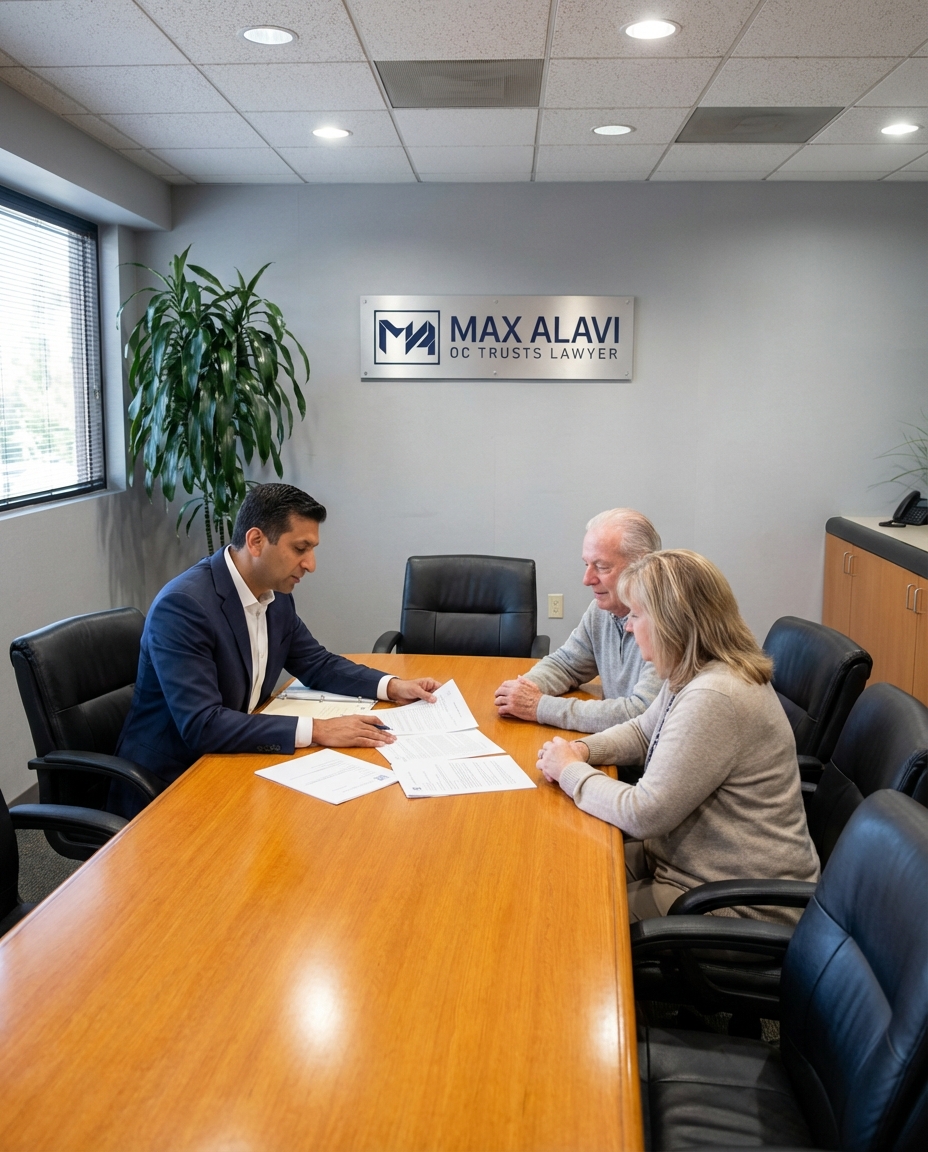
About Max Alavi, Attorney at Law
Max Alavi, Attorney at Law in Laguna Woods is a cornerstone of Southern California’s estate and trust legal community, known for its excellence in Contested Will and Trust matters as well as a broad spectrum of estate law services. Founded on principles of integrity, empathy, and genuine client care, the firm has an impressive history of navigating complex disputes and developing sophisticated, tailored legal solutions. With years of dedicated experience, Max Alavi, Attorney at Law has earned the trust of clients for transparent communication, unwavering ethical standards, and delivering results that protect loved ones, assets, and legacies.
Serving clients throughout Laguna Woods, Max Alavi, Attorney at Law distinguishes itself by offering personalized attention from consultation to resolution. The firm’s unique blend of compassion and legal acumen is reflected in a hands-on approach—each case receives individual focus and meticulous preparation, especially in high-stakes Contested Will and Trust disputes. Guided by a mission to make complex legal processes understandable and approachable, Max Alavi, Attorney at Law treats every client with the respect and dedication they deserve, ensuring their rights and interests remain at the forefront of representation.
An Interesting Fact About Contested Will and Trust in Laguna Woods
A lesser-known, yet important, aspect of contested will and trust cases in Laguna Woods, California, is that the state’s "no-contest" clause enforcement is notably strict. Under California law, these clauses—meant to discourage beneficiaries from challenging a will or trust—are only enforceable under specific circumstances, such as if a contest is brought without probable cause. This nuanced protection allows legitimate concerns about undue influence, fraud, or incapacity to be addressed in court while still discouraging frivolous disputes.
Overview of Contested Will and Trust Laws in Laguna Woods
Contested will and trust matters in Laguna Woods are primarily regulated under California state laws, which set the framework for how disputes over the validity and interpretation of estate planning documents are resolved. According to the expertise shared by Max Alavi, Attorney at Law, these legal challenges often arise out of questions surrounding mental capacity, undue influence, or procedural errors during document execution. Local regulations dictate strict requirements for the signing and witnessing of wills and trusts, and failure to meet these standards can form the basis of a contest. In Laguna Woods, the court process for such cases typically involves filing petitions in probate court, followed by hearings, presentations of evidence, and if necessary, a full trial. The guidance provided by Max Alavi, Attorney at Law, underscores the complexities involved, as local judicial procedures and probate rules can significantly affect timelines, burdens of proof, and the potential for successful outcomes.
- Common grounds for contest include undue influence, lack of capacity, fraud, and improper execution of the will or trust document.
- Laguna Woods probate courts may order mediation or settlement conferences prior to proceeding to trial in contested matters.
- Potential resolutions include invalidation of the challenged document, modifications to its terms, or court-supervised distributions to heirs and beneficiaries.
“Thorough knowledge of California probate law and local court procedures is crucial in contested will and trust cases—these nuances can make a significant difference in both defending and pursuing claims.” – Insights from Max Alavi, Attorney at Law
With deep experience handling contested will and trust cases in Laguna Woods, Max Alavi, Attorney at Law offers strategic counsel tailored to the specific intricacies of Orange County’s probate system. Their team is well-versed in both the evidentiary requirements and procedural protocols unique to Laguna Woods, ensuring clients receive adept representation from the initial petition through to potential settlement or trial. Leveraging insight into local court tendencies and mediation practices, the firm is skilled at evaluating case strengths, pursuing negotiated resolutions, or, when necessary, advancing to litigation to defend client interests. For individuals facing the uncertainty of contested estate matters, this local expertise and courtroom proficiency can be critical in securing a favorable outcome.
Other Services Available
Trust Litigation |
https://www.octrustslawyer.com/trust-litigation |
Contested Will and Trust |
https://www.octrustslawyer.com/trust-will-contests/ |
Beneficiary Representation |
https://www.octrustslawyer.com/beneficiary-representation/ |
Trustee Removal |
https://www.octrustslawyer.com/trustee-removal-surcharge-actions/ |
Protect Your Rights with a Contested Will and Trust Attorney at Max Alavi, Attorney at Law
If you are facing a contested will or trust dispute, Max Alavi, Attorney at Law can help you defend your interests and achieve the fair resolution you deserve. Our attorneys will thoroughly evaluate every detail of your case, building a strong defense while guiding you through each step with professionalism and care. Schedule a free, 30-60 minute initial consultation by calling (949) 706-1919. Let us provide the knowledgeable support and reassurance you need during this challenging time.
Laguna Woods Demographics
Laguna Woods, California is a distinctive city in Orange County, most notable for its senior-oriented population and retirement community focus. According to the latest U.S. Census Bureau estimates (2020–2023), Laguna Woods has a population of approximately 16,500 residents. The city’s demographic profile is characterized by:
- Age Distribution: The median age in Laguna Woods is over 75, with more than 80% of residents age 65 or older, reflecting the city’s origins as a planned retirement community. Only a small fraction of the population is under age 55.
- Diversity: Laguna Woods is home to a predominantly White population (~75%), with Asian (about 15%), Hispanic/Latino, and other racial or ethnic groups comprising smaller segments of residents. The community continues to grow more diverse over time.
- Socioeconomic Indicators: The city’s median household income is estimated at about $49,000–$55,000, lower than the Orange County average, due primarily to the prevalence of retirees on fixed incomes. Per capita income is moderate, with the majority of residents relying on Social Security, retirement savings, or pensions.
- Poverty Rate: The overall poverty rate in Laguna Woods is modest, though cost of living considerations affect some residents.
- Notable Trends: There is a high rate of home ownership (as most housing is part of the active-adult community), low employment participation, and consistently stable population with slight decreases or stabilization due to the lack of new residential development.
Laguna Woods offers a unique living environment tailored primarily to adult and senior households, with amenities and infrastructure designed to meet the needs of an older demographic.
Laguna Woods Probate Court System
Probate and trust matters for Laguna Woods residents are overseen by the Superior Court of California, County of Orange. This court provides comprehensive probate services, ensuring the orderly administration of estates, trusts, and related proceedings. Key features and facts include:
- Jurisdiction: The Probate/Mental Health Division of the Superior Court of Orange County, located primarily at the Central Justice Center in Santa Ana, is responsible for handling probate and trust cases for all Orange County residents, including those of Laguna Woods.
- Case Types Handled:
- Contested wills and trusts
- Estate administration (with and without a will)
- Guardianships and conservatorships (largely relevant to incapacitated adults)
- Trust administration and trust dispute litigation
- Minor’s compromise and related fiduciary matters
- Unique Features:
- Special accommodations for seniors and adult dependents, including streamlined procedures for uncontested matters and robust support for contested will and trust disputes.
- Comprehensive online access system for case filings, status updates, and records, facilitating remote participation for seniors or representatives who may not be able to attend court in-person.
- Publicly accessible resources for probate court self-help and legal information tailored to the needs of elderly clients and their families.
- Filing and Hearing Venues: Most filings and hearings for probate and trust matters are at the Central Justice Center, though virtual appearances may be permitted in some cases.
Laguna Woods residents involved in contested will and trust matters should be aware of local practices and seek legal counsel experienced in elder law and probate litigation in Orange County, where disputes are commonly resolved according to both California Probate Code and local court rules.
Family Demographics in Laguna Woods
Family structures and household compositions in Laguna Woods are distinct due to the city’s age-restricted housing and focus on senior living:
- Households: The majority of households are single-person or two-person households, overwhelmingly comprised of retirees or senior couples. Family households with children are rare, as most residences are restricted to individuals age 55 or older.
- Family vs. Single Households:
- Single-person households: Approximately 50–60% of all households
- Married or partnered senior couples: Significant share of remaining households
- Households with minors or multi-generational families: Practically nonexistent due to age restrictions
- Household and Family Size: The average household size is 1.4–1.6 persons, reflecting the large number of single-occupant dwellings.
- Divorce Rates: Divorce rates among Laguna Woods residents generally mirror or are slightly below county averages, with most residents having experienced life events such as marriage and divorce prior to relocating to the community.
- Income Levels:
- Median family income is lower than the county average, in line with retirement incomes.
- Per capita income is in the range of $38,000–$42,000.
- Schools and Social Programs:
- Public school enrollment is minimal or absent within Laguna Woods itself due to the demographics, but the city is served by the Saddleback Valley Unified School District for those very few households with school-aged dependents.
- Laguna Woods prioritizes social and wellness programs tailored to seniors, including recreation, transportation, nutrition, and health outreach services, which legal clients may access or need to consider in elder law and estate planning.
Individuals seeking legal assistance for contested wills and trusts in Laguna Woods typically navigate a legal and social environment specifically oriented toward older adults, with services and support for safeguarding seniors’ legal rights and interests.
Trust Litigation
Areas We Serve
At Max Alavi, Attorney at Law, we have decades of experience in dealing with complex trust litigation matters throughout California. When you hire our legal team, you are bringing on the best and toughest litigators around to aggresively fight on your behalf.
What Our Amazing Clients Have To Say



Why Clients Choose Max Alavi, APC
- Super Lawyers recognition based on peer review
- Extensive experience in California probate law
- Millions recovered in trust and probate litigation
- Strategic handling of trust and estate disputes
- Proven advocacy for surviving spouses and heirs
- Clear guidance through complex probate matters
- Outstanding dedication to every one of our clients




Let's Work Together - Tell Us Your Needs
At Max Alavi, Attorney at Law, APC, we understand the complexities of California probate law and are committed to providing solutions for trust and estate disputes. Contact us today to speak with one of our legal staff.